
A knowledge graph for data-driven electricity management
Residential electricity use accounts for roughly a quarter of global consumption, yet household-level data is scattered across incompatible regional formats. The Electricity Knowledge Graph (ELKG) unifies 20 public datasets from 14 countries into one harmonized resource and an RDF knowledge graph — queryable via SPARQL and linked to Wikidata and DBpedia.
The problem
As detailed in the paper, residential electricity consumption makes up roughly 25% of global electricity use, giving it real potential for efficiency gains and CO₂ reduction. But research into that potential is blocked by the state of the underlying data: household-level electricity consumption datasets are published independently by research groups around the world, each with its own format, sampling rate, units, and metadata conventions.
That fragmentation makes it difficult to build robust models or run studies across regions. And even where the raw numbers exist, there has been no semantic resource connecting household energy data to open knowledge bases — so contextual facts like a household's country, city, or that city's GDP have to be looked up and joined by hand.
- Incompatible formats and sampling rates across regional datasets
- No uniform schema for households, devices, or appliances
- No semantic links from consumption data to open, queryable knowledge bases
Methodology
The knowledge graph is produced by an eight-stage pipeline, with a parallel machine-learning branch that predicts appliance on/off states for datasets that only provide aggregate household consumption.
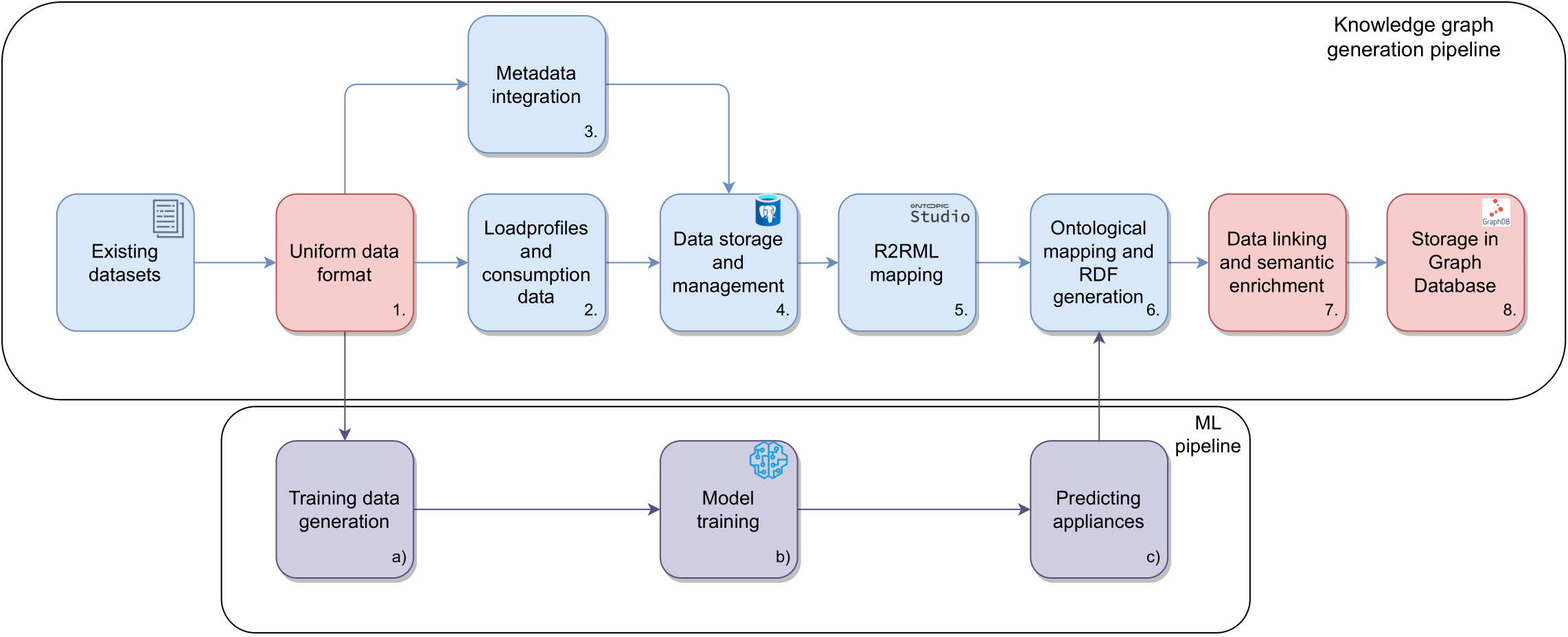
- Uniform data format — diverse raw formats (CSV, parquet, XLS) are parsed into a common nested structure.
- Load profiles & consumption data — daily, weekly, and monthly aggregations are computed per household.
- Metadata integration — household properties and socio-economic data are attached.
- Data storage & management — harmonized data is staged in PostgreSQL.
- R2RML mapping — the relational data is mapped to RDF using Ontopic Studio.
- Ontological mapping & RDF generation — the graph is structured with the SAREF and schema.org standards.
- Data linking & semantic enrichment — entities are linked to Wikidata and DBpedia via fuzzy string matching.
- Storage in a graph database — the final graph is deployed to a Blazegraph triple store with a public SPARQL endpoint.
Machine-learning branch: for datasets that only report aggregate household power, an ensemble of 10 InceptionTime models — trained on 100,000 synthetic household windows covering 64 appliance classes — predicts individual appliance on/off states, reaching an F1-score of 0.62 versus a 0.42 state-of-the-art baseline.
Knowledge graph & ontology
The graph is built on 6 core entity types (including households, devices, and places),
described with 38 predicates drawn from the SAREF and schema.org standards, and contains
1,936 appliance instances. Households are linked outward to open knowledge bases: 12
cities and 14 countries are connected to their Wikidata and DBpedia counterparts via owl:sameAs,
enriching the graph with external facts like geography and GDP.
PREFIX voc: <https://elkg.ijs.si/ontology/>
PREFIX saref: <https://saref.etsi.org/core/>
PREFIX schema: <https://schema.org/>
Datasets
ELKG harmonizes 20 publicly available household electricity datasets spanning 14 countries: the United Kingdom, Canada, Switzerland, the Netherlands, Portugal, Greece, Germany, France, Poland, the USA, Uruguay, India, South Korea, and Pakistan.
Explore the graph, live
Query the knowledge graph directly or browse it as Linked Data — no setup required.
SPARQL query interface
Open full screen ↗Run read-only SPARQL queries against the live knowledge graph. Queries are forwarded server-side to the ELKG endpoint.
Linked Data browser
Open in new tab ↗Browse individual resources in the graph — households, devices, cities — as human-readable pages, powered by LodView.
Cite this work
Hanžel, V., Bertalanič, B., & Fortuna, C. (2025). Towards data-driven electricity management: multi-region uniform data and knowledge graph. Scientific Data, 12(38). https://doi.org/10.1038/s41597-024-04310-z
@Article{Hanzel2025,
  author={Hanžel, Vid and Bertalanič, Blaž and Fortuna, Carolina},
  title={Towards data-driven electricity management: multi-region uniform data and knowledge graph},
  journal={Scientific Data},
  year={2025},
  month={Jan},
  day={09},
  volume={12},
  number={1},
  pages={38},
  issn={2052-4463},
  doi={10.1038/s41597-024-04310-z},
  url={https://doi.org/10.1038/s41597-024-04310-z}
}